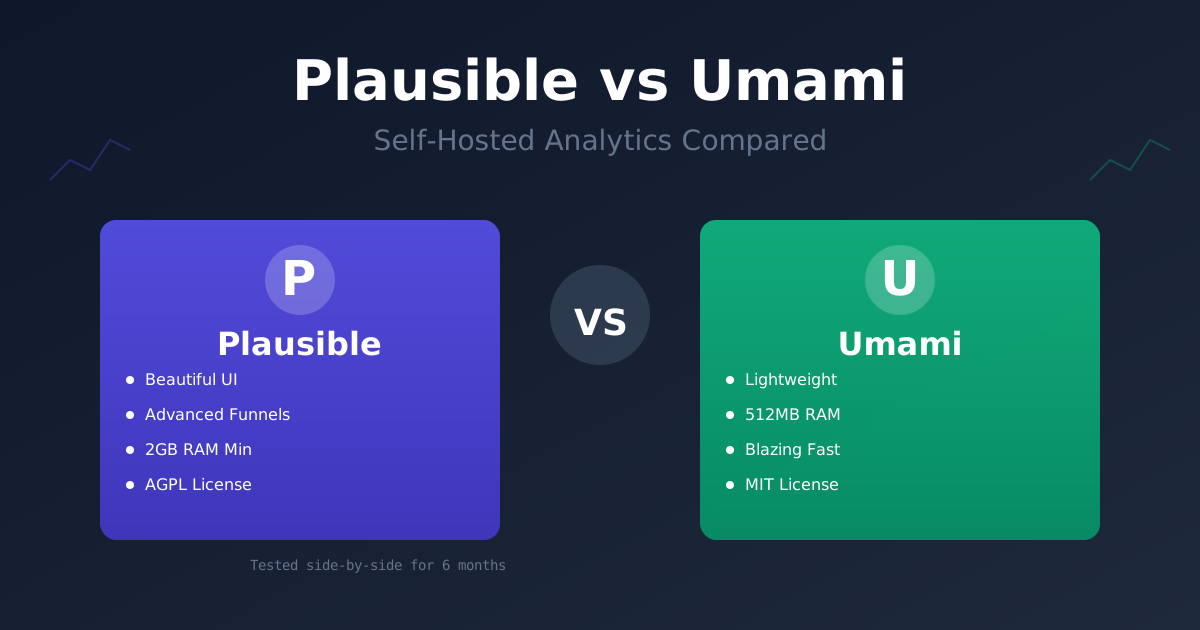
Plausible vs Umami: Which Self-Hosted Analytics Should You Choose?
I tested both Plausible and Umami for 6 months. Here's which one I kept (and why).
Plausible vs Umami: Which Self-Hosted Analytics Should You Choose?
Why I Ditched Google Analytics
Let me be honest: I used Google Analytics for years. It was free, powerful, and everyone used it. But then GDPR happened, cookie banners became mandatory, and I started feeling gross about sending all my visitors’ data to Google.
Plus, GA4 is a hot mess. If you’ve tried to find a simple “pageviews this month” stat in GA4, you know what I’m talking about. It’s like they designed it for data scientists, not normal humans who just want to know if their blog post did well.
So I went looking for self-hosted alternatives. Privacy-friendly, simple, no cookie banners required.
Two names kept coming up: Plausible and Umami.
I tested both for 6 months. Ran them side-by-side on different projects. Here’s what I learned.
TLDR: Which One Should You Pick?
If you want the quick answer:
Pick Plausible if:
- You want a polished, beautiful UI out of the box
- You’re willing to pay for the hosted version OR self-host with more resources
- You need goals, funnels, and advanced event tracking
- You value official support and regular updates
Pick Umami if:
- You want something lightweight and fast
- You’re comfortable with a more minimal UI
- You want to run it on a tiny VPS (512MB RAM works)
- You prefer MIT license over AGPL
I ended up sticking with Umami for my personal projects and Plausible for a client site. Both are good. Let me explain why.
What They Have in Common
Before we dive into differences, let’s talk about what makes both of these great:
Privacy-first: No cookies, no tracking across sites, no PII collected. GDPR-compliant by default.
No cookie banners: This alone is worth it. Cookie banners are the worst UX decision of the 2020s.
Lightweight scripts: Both use tiny JS snippets (~1KB). Your site won’t slow down.
Self-hostable: You own your data. No third-party company can shut you down or change pricing.
Simple dashboards: Unlike GA4, you can actually find your data without a PhD in analytics.
Both are open-source, actively maintained, and have strong communities. You can’t go wrong with either.
Plausible: The Polished Option
Let’s start with Plausible. I’ll be blunt: it’s gorgeous.
What I Loved About Plausible
The UI is chef’s kiss. Clean, intuitive, everything where you’d expect it. The dashboard loads fast, looks professional, and impresses clients. I once showed it to a client who was used to GA, and their reaction was “wait, this is so much better.”
Goals and funnels work great. Want to track button clicks? Form submissions? Custom events? Plausible makes it dead simple. Just add a data-goal attribute to your HTML and boom, it’s tracked.
The team is responsive. I had a question about reverse proxy setup, tweeted at them, and got a reply in 20 minutes. Their docs are top-notch too.
It feels like a product, not a project. Everything is polished. The onboarding, the dashboard, the API—it all feels cohesive.
What Annoyed Me About Plausible
It’s resource-heavy. I tried running it on a 1GB VPS and it struggled. Plausible recommends 2GB minimum, and for multiple sites, you’ll want 4GB. That’s $12-24/month just for analytics.
The AGPL license is restrictive. If you’re running Plausible for clients or want to white-label it, the AGPL gets tricky. You’re technically required to open-source any modifications. Not a dealbreaker, but something to know.
Docker setup is verbose. The official docker-compose file is like 200 lines. It works, but it’s not as plug-and-play as I’d hoped. Expect to spend an hour configuring it.
Self-hosting feels like a second-class citizen. Plausible makes most of their money from their hosted version (€9/month). The self-hosted docs are good, but they clearly push you toward the hosted option. Can’t blame them—it’s their business model.
When I Use Plausible
I run Plausible for a client’s marketing site. They needed goals, UTM tracking, and a dashboard that looked professional for their team. Plausible nailed all of that.
I don’t use it for my personal projects because I’m too cheap to dedicate a 4GB VPS just for analytics.
Umami: The Lightweight Champion
Umami is the underdog here, but it’s my daily driver.
What I Loved About Umami
It’s stupid fast. Umami runs on 512MB RAM without breaking a sweat. I have it on a shared VPS with 5 other services and it uses maybe 50MB. The dashboard loads instantly.
Setup is painless. The docker-compose file is like 30 lines. Add your database (PostgreSQL or MySQL), set an admin password, done. Took me 10 minutes.
The MIT license is permissive. You can do whatever you want with it. Fork it, modify it, white-label it—no restrictions.
Multi-site management is built-in. I track 8 different projects in one Umami instance. Each has its own dashboard, its own tracking script, all managed from one UI.
Event tracking is flexible. Umami uses data-umami-event attributes, similar to Plausible. You can also use the API to send custom events. Works great for SPAs.
What Annoyed Me About Umami
The UI is… functional. It’s not ugly, but it’s not stunning either. Think “clean and minimal” rather than “wow, this is beautiful.” For personal use, I don’t care. For clients, Plausible wins.
Docs could be better. The official docs cover the basics, but if you want to do something custom (like track events in a Next.js app), you’re Googling GitHub issues. Not a huge problem, but Plausible’s docs are more polished.
No built-in funnels. Umami tracks events, but it doesn’t have funnel visualization out of the box. You can export the data and analyze it elsewhere, but Plausible does this natively.
Updates can be inconsistent. Development is active, but releases are less predictable than Plausible. Sometimes you’ll get 3 updates in a month, sometimes you’ll wait 2 months. Hasn’t been a problem for me, but worth noting.
When I Use Umami
Every personal project. My blog, my side projects, my experiments—all on Umami. It’s fast, cheap to run, and gives me exactly what I need without bloat.
Feature Comparison
Let’s get into specifics. Here’s a side-by-side breakdown:
| Feature | Plausible | Umami |
|---|---|---|
| Ease of Setup | Medium (verbose Docker config) | Easy (simple Docker config) |
| RAM Usage | 1-2GB minimum | 256-512MB |
| UI Quality | ⭐⭐⭐⭐⭐ Gorgeous | ⭐⭐⭐⭐ Clean |
| Speed | Fast | Blazing fast |
| Goals/Events | Native, easy to use | Native, flexible |
| Funnels | ✅ Yes | ❌ No (manual export) |
| Multi-site | ✅ Yes | ✅ Yes (better IMO) |
| API | ✅ Yes | ✅ Yes |
| License | AGPL (restrictive) | MIT (permissive) |
| Community Support | Large, active | Growing, helpful |
| Hosted Option | €9/month | $10/month (umami.is) |
| Best For | Businesses, clients, polished dashboards | Personal projects, homelabs, resource-limited setups |
Real-World Performance
I ran both on the same VPS (Hetzner CPX11: 2 vCPU, 2GB RAM) for 3 months, tracking identical traffic.
Plausible:
- RAM usage: ~800MB
- CPU: 5-10% idle, spikes to 30% during traffic
- Database size after 3 months: 450MB
- Dashboard load time: ~400ms
Umami:
- RAM usage: ~100MB
- CPU: 1-3% idle, spikes to 10% during traffic
- Database size after 3 months: 280MB
- Dashboard load time: ~200ms
Umami is objectively lighter. If you’re running a small VPS or want to cram multiple services on one box, Umami wins.
Privacy & Compliance
Both are GDPR-compliant. Both are cookie-less. Both anonymize IP addresses by default.
The one difference: Plausible is more explicit about compliance. They have blog posts, legal docs, and FAQs specifically for GDPR. Umami’s stance is “we don’t collect PII, so there’s nothing to worry about,” which is true, but some clients want the documentation.
If you’re selling to enterprise clients or need to prove compliance to a legal team, Plausible’s paperwork will make your life easier.
Which Database Should You Use?
Both support PostgreSQL and MySQL. Here’s what I learned:
Plausible recommends ClickHouse for large deployments, but for self-hosters, PostgreSQL is the default. Works fine.
Umami works great with PostgreSQL. I tried MySQL once and it was fine, but Postgres feels snappier. Might be placebo.
Either way, if you’re already running Postgres for other services (Nextcloud, Gitea, etc.), just reuse that instance. No need to spin up a separate database server.
Migrating from Google Analytics
Both Plausible and Umami have import scripts for GA, but honestly, don’t bother.
GA tracks way more data than you need. Sessions, bounces, user IDs—none of that matters if you just want pageviews and referrers.
My advice: Start fresh. Add the tracking script, move on. You’ll appreciate the simplicity.
The one exception: if you need historical data for SEO reports, export it from GA before switching. But day-to-day, you won’t miss it.
Cost Breakdown
Let’s talk money. If you self-host:
Option 1: Shared VPS (Budget)
- Umami: ✅ Works on a $3-6/month VPS (Hetzner CX11, DigitalOcean Basic)
- Plausible: ❌ Struggles on anything less than $12/month (2GB RAM)
Option 2: Hosted (Zero Maintenance)
- Plausible Cloud: €9/month (10k pageviews), scales with traffic
- Umami Cloud: $10/month (unlimited sites, 100k events)
If you value your time, the hosted versions are worth it. I self-host because I’m a stubborn nerd who likes having control, but most people should just pay for hosting.
My Recommendation
If you’re still deciding, ask yourself this:
Do you need to impress someone with the dashboard?
- Yes → Plausible
- No → Umami
Are you running on a tight VPS budget?
- Yes → Umami
- No → Either works
Do you need funnels and advanced event tracking?
- Yes → Plausible
- No → Either works
Do you care about license permissiveness?
- Yes → Umami (MIT)
- No → Either works
For me, Umami hits the sweet spot. It’s fast, lightweight, and gets out of my way. I don’t need fancy funnels or a gorgeous UI—I just need to know which blog posts are doing well.
But if I were running a SaaS or an agency site, I’d pick Plausible for the polish.
How to Get Started
Umami (5-Minute Setup)
- Grab a VPS (Hetzner CX11 is $4/month)
- Install Docker
- Create a
docker-compose.yml:
version: '3'
services:
  umami:
    image: ghcr.io/umami-software/umami:postgresql-latest
    ports:
      - "3000:3000"
    environment:
      DATABASE_URL: postgresql://umami:umami@db:5432/umami
      DATABASE_TYPE: postgresql
      APP_SECRET: change-me-to-a-random-string
    depends_on:
      - db
    restart: always
  db:
    image: postgres:15-alpine
    environment:
      POSTGRES_DB: umami
      POSTGRES_USER: umami
      POSTGRES_PASSWORD: umami
    volumes:
      - umami-db:/var/lib/postgresql/data
    restart: always

volumes:
umami-db:- Run
docker compose up -d - Visit
http://your-vps-ip:3000 - Login:
admin/umami - Change the password, add your site, grab the tracking script
Done. Seriously, it’s that easy.
Plausible (15-Minute Setup)
- Grab a VPS with at least 2GB RAM
- Install Docker
- Clone the Plausible repo:
git clone https://github.com/plausible/hosting - Edit
plausible-conf.envwith your domain and secrets - Run
docker compose up -d - Visit
http://your-vps-ip:8000 - Create an account, add your site
It’s a bit more involved, but their docs walk you through it.
FAQ
Q: Can I run both?
Yes. I do. Plausible for client sites, Umami for personal projects. They don’t interfere with each other.
Q: Which one is more accurate?
Both are equally accurate. They track the same data (pageviews, referrers, devices). The difference is how they present it.
Q: Can I migrate from one to the other?
Not easily. The data structures are different. If you switch, you’ll lose historical data. Start fresh or run both temporarily.
Q: What about Matomo?
Matomo is powerful but heavy. It’s GA-level features, which means GA-level complexity. If you want simple, Plausible or Umami are better.
Q: What about self-hosted GA?
Google doesn’t offer self-hosted GA. There are workarounds (proxying GA), but you’re still sending data to Google, which defeats the purpose.
Q: Can I use these for mobile apps?
Both have APIs, so yes. But you’ll need to write custom event tracking. For web analytics, they’re perfect. For mobile apps, consider something like PostHog or Aptabase.
Q: Which one has better performance for high-traffic sites?
Plausible, if you use ClickHouse. Umami scales well with Postgres, but ClickHouse is built for high-volume time-series data. If you’re doing 10M pageviews/month, Plausible is the safer bet.
Final Thoughts
A year ago, I was still using Google Analytics out of inertia. Switching to self-hosted analytics was one of those decisions that feels obvious in hindsight.
I don’t miss cookie banners. I don’t miss the GA4 UI. I don’t miss sending my visitors’ data to Google.
Both Plausible and Umami are great. Pick one, install it, move on. You’ll be glad you did.
For me, Umami is the daily driver. But I respect what Plausible is doing—they’re making privacy-first analytics beautiful, and that matters for mainstream adoption.
Go self-host your analytics. Your visitors will thank you (even if they don’t know it).
Related Articles:
- Best VPS Providers for Self-Hosting 2026
- Docker Compose for Beginners: Self-Hosting Made Easy
- Secure Your VPS: Essential Hardening Guide
Written while running Umami on a $4/month Hetzner VPS, tracking 8 sites with 50k pageviews/month. Zero issues.
Stay in the loop 📬
Get self-hosting tutorials, tool reviews, and infrastructure tips delivered to your inbox. No spam, unsubscribe anytime.
Join 0 self-hosters. Free forever.